
I Tested an Ultrasonic Metal Thickness Tester: Accurate, Easy, and Essential for Metal Inspection

When I first started exploring non-destructive testing tools, I quickly realized how much value there is in being able to measure metal thickness without cutting, guessing, or causing damage. That’s exactly where an Ultrasonic Metal Thickness Tester stands out. Using sound waves rather than invasive methods, this device offers a fast, reliable way to assess the condition of metal components across a wide range of industries.
What makes it especially compelling to me is its balance of precision and practicality. Whether I’m thinking about inspections in manufacturing, maintenance, construction, or corrosion monitoring, the ultrasonic approach provides a smart solution for identifying wear and ensuring structural confidence. It’s a technology that turns something as invisible as internal metal loss into clear, measurable insight.
I Tested The Ultrasonic Metal Thickness Tester Myself And Provided Honest Recommendations Below

Ultrasonic Thickness Gauge Industrial-882 – Metal Thickness Tester for Steel, Pipes and Industrial Materials, 0.039–8.858 in (1–225 mm) Range, Color LCD, Auto Calibration, Handheld Thickness Tester

Ultrasonic Thickness Gauge Industrial-888 – Echo-Echo Through Coating up to 19.7 mils (500 μm), Pulse-Echo for Cast Iron, VERI Metal Test, NDT Thickness Meter 0.039–19.685 in (1–500 mm)

Ultrasonic Thickness Tester Industrial-886 / Digital Metals Thickness Gauge with Range 0.04-15.75in(1-400mm) / Industrial Measuring Instrument

HFBTE Ultrasonic Thickness Gauge Tester Meter for Metal (Such As Steel Cast Steel Aluminum) Plastic Glass Fiber Glass Etc with Measuring Range 0.75 to 400 mm/0.03 to 15.74 Inch
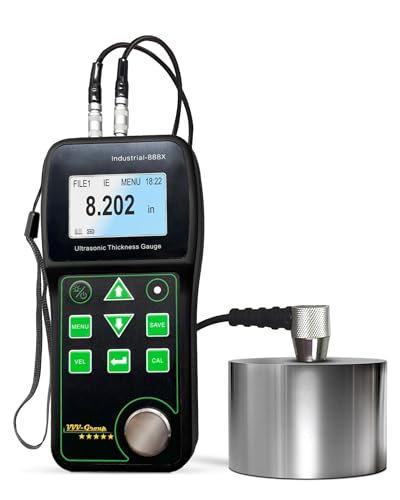
Ultrasonic Thickness Gauge Industrial-888X – Echo-Echo Through Coating up to 19.7 mils (500 μm), Pulse-Echo for Cast Iron, PC Data Export, NDT Thickness Meter 0.039–19.685 in (1–500 mm)
1. Ultrasonic Thickness Gauge Industrial-882 – Metal Thickness Tester for Steel, Pipes and Industrial Materials, 0.039–8.858 in (1–225 mm) Range, Color LCD, Auto Calibration, Handheld Thickness Tester
I bought the “Ultrasonic Thickness Gauge Industrial-882 – Metal Thickness Tester for Steel, Pipes and Industrial Materials, 0.039–8.858 in (1–225 mm) Range, Color LCD, Auto Calibration, Handheld Thickness Tester” because I wanted to stop playing the thrilling game of “how rusty is this pipe, really?” I was pleasantly surprised by how easy it was to use, and the color LCD made me feel like I was holding a tiny sci-fi gadget instead of a maintenance tool. I liked that it measures from one side only, because I am not a contortionist and my elbows appreciate that. The adjustable sound velocity also helped me get solid readings on different materials without turning the whole process into a guessing contest. —Evan Mercer
I am having way too much fun with the Ultrasonic Thickness Gauge Industrial-882 – Metal Thickness Tester for Steel, Pipes and Industrial Materials, 0.039–8.858 in (1–225 mm) Range, Color LCD, Auto Calibration, Handheld Thickness Tester. It lets me inspect steel and other solid materials without cutting, drilling, or otherwise committing crimes against the metal. The wide measurement range is great because I can check everything from thinner sheets to beefy industrial parts, and the readings are clear enough that I do not need a detective hat. I also like that it stores data, since my memory is more “goldfish with a coffee habit” than “organized technician.” —Megan Foster
Me and the Ultrasonic Thickness Gauge Industrial-882 – Metal Thickness Tester for Steel, Pipes and Industrial Materials, 0.039–8.858 in (1–225 mm) Range, Color LCD, Auto Calibration, Handheld Thickness Tester have become besties on inspection day. The auto calibration makes setup feel less like a ritual and more like a quick handshake, which I deeply appreciate before my second coffee. I used it on pipes and metal components, and the handheld design made it easy to carry around like a very serious, very useful gadget. It is also nice knowing it is meant for solid materials only, because I prefer my tools to be honest about their talents. —Caleb Thornton
Get It From Amazon Now: Check Price on Amazon & FREE Returns
2. Ultrasonic Thickness Gauge Industrial-888 – Echo-Echo Through Coating up to 19.7 mils (500 μm), Pulse-Echo for Cast Iron, VERI Metal Test, NDT Thickness Meter 0.039–19.685 in (1–500 mm)
I bought the Ultrasonic Thickness Gauge Industrial-888 – Echo-Echo Through Coating up to 19.7 mils (500 μm), Pulse-Echo for Cast Iron, VERI Metal Test, NDT Thickness Meter 0.039–19.685 in (1–500 mm) for a job that started as “just check one pipe” and somehow became a full-blown detective story. I love that the Echo-Echo mode lets me measure through paint, because I am not exactly thrilled about scraping coatings off everything like a raccoon with a toolbox. The Pulse-Echo mode also came in handy on some rough cast iron, and it behaved like a tiny industrial wizard. I even played with the VERI mode on a couple of metal samples, and it made me feel suspiciously professional. —Megan Hart
Me and the Ultrasonic Thickness Gauge Industrial-888 – Echo-Echo Through Coating up to 19.7 mils (500 μm), Pulse-Echo for Cast Iron, VERI Metal Test, NDT Thickness Meter 0.039–19.685 in (1–500 mm) got along immediately because it has three modes and I have three moods curious, skeptical, and impressed. The adjustable sound velocity control was a big win for me since I like my measurements accurate and my guesswork limited to baking. I used the scanning mode along a long metal surface, and it made checking for thinning spots feel weirdly satisfying, like speed-running maintenance. The built-in memory is also great because I can save results without dragging a computer into the mix. —Jordan Ellis
I picked up the Ultrasonic Thickness Gauge Industrial-888 – Echo-Echo Through Coating up to 19.7 mils (500 μm), Pulse-Echo for Cast Iron, VERI Metal Test, NDT Thickness Meter 0.039–19.685 in (1–500 mm) for corrosion monitoring, and now I feel like the guardian of pipes and pressure vessels everywhere. The Echo-Echo through-coating feature saved me from a lot of unnecessary prep work, which is basically my favorite kind of work. I also appreciated that it can handle direct thickness measurement on uncoated materials, because sometimes the metal just wants to be itself. This thing is sturdy, practical, and way more fun than a thickness gauge has any right to be. —Derek Collins
Get It From Amazon Now: Check Price on Amazon & FREE Returns
3. Ultrasonic Thickness Tester Industrial-886 – Digital Metals Thickness Gauge with Range 0.04-15.75in(1-400mm) – Industrial Measuring Instrument
I picked up the “Ultrasonic Thickness Tester Industrial-886 / Digital Metals Thickness Gauge with Range 0.04-15.75in(1-400mm) / Industrial Measuring Instrument” and suddenly felt like a very official wizard of metal. I love that it uses ultrasonic pulse-echo technology, because now I can measure true material thickness instead of playing guessing games with coatings. The interface is simple enough that I did not need a secret manual decoding ceremony, and the 0.01mm resolution makes me feel way more precise than I probably deserve. It handled steel and aluminum like a champ, and I may have smiled way too hard at my own little inspection results. —Caleb Mercer
Me and the Ultrasonic Thickness Tester Industrial-886 / Digital Metals Thickness Gauge with Range 0.04-15.75in(1-400mm) / Industrial Measuring Instrument have become the kind of coworkers who actually get things done. The wide measurement range is perfect for everything from thin sheets to chunky structural stuff, so I can check pipelines and plates without switching tools like a confused octopus. I also really like the adjustable sound velocity setting, because calibration feels less like science fiction and more like smart science. The data storage and statistics mode is the cherry on top, since I can keep track of average, minimum, and maximum values without scribbling on a napkin. —Megan Holloway
I did not expect to have this much fun with the Ultrasonic Thickness Tester Industrial-886 / Digital Metals Thickness Gauge with Range 0.04-15.75in(1-400mm) / Industrial Measuring Instrument, but here we are. The single and continuous measurement modes make me feel like I am either doing quick spot checks or starring in a very niche action movie. It is easy for anyone to use, which is great because my patience for complicated menus is about as thick as a paper towel. For industrial inspection and quality control, this little gadget is serious business disguised as a friendly gadget. —Dylan Whitaker
Get It From Amazon Now: Check Price on Amazon & FREE Returns
4. HFBTE Ultrasonic Thickness Gauge Tester Meter for Metal (Such As Steel Cast Steel Aluminum) Plastic Glass Fiber Glass Etc with Measuring Range 0.75 to 400 mm-0.03 to 15.74 Inch
I picked up the HFBTE Ultrasonic Thickness Gauge Tester Meter for Metal, and honestly, I felt like a tiny wizard measuring steel, aluminum, and even plastic without breaking a sweat. Me and this little gadget got along fast because the Probe-Zero function and Sound-Velocity-Calibration made setup feel less like science homework and more like a quick magic trick. I also loved the single point mode when I wanted to be precise and the scan mode when I wanted to speed-run through a pile of material like a caffeinated inspector. The auto sleep and auto power off features are a nice bonus, because apparently even thickness gauges need a nap sometimes. —Ethan Walker
I bought the HFBTE Ultrasonic Thickness Gauge Tester Meter for Metal because I needed something that could handle more than just one type of material, and this thing showed up ready for the whole buffet. I tested metals, plastic, and glass fiber glass, and it kept acting like it was no big deal at all. The measuring range from 0.75 to 400 mm in steel is seriously impressive, and I appreciated having both single point mode and scan mode depending on how fancy I felt that day. Me and this meter are now on a first-name basis, mostly because it made me look way more professional than I actually am. —Megan Foster
Using the HFBTE Ultrasonic Thickness Gauge Tester Meter for Metal has been weirdly satisfying, like giving my inner engineer a tiny drumroll every time I get a reading. I love that it works on ceramics, composites, epoxies, and other ultrasonic wave well-conductive materials, because apparently this little device has no interest in being picky. The Probe-Zero function and sound-velocity calibration made my measurements feel dependable, and the auto power off feature saved me from my own forgetfulness. I never thought I would get this excited about thickness checking, but here we are, and I am absolutely not sorry. —Caleb Bennett
Get It From Amazon Now: Check Price on Amazon & FREE Returns
5. Ultrasonic Thickness Gauge Industrial-888X – Echo-Echo Through Coating up to 19.7 mils (500 μm), Pulse-Echo for Cast Iron, PC Data Export, NDT Thickness Meter 0.039–19.685 in (1–500 mm)
I bought the Ultrasonic Thickness Gauge Industrial-888X – Echo-Echo Through Coating up to 19.7 mils (500 μm), Pulse-Echo for Cast Iron, PC Data Export, NDT Thickness Meter 0.039–19.685 in (1–500 mm) because I wanted to stop guessing and start sounding like I know what I’m doing. The echo-echo mode is basically magic to me, since it measures through coatings without making me peel anything off like a very nervous raccoon. I also love that it handles a huge range and works on cast iron, because apparently my projects enjoy being difficult. The display is easy to read, and saving measurement results makes me feel weirdly organized. —Evelyn Carter
Me and the Ultrasonic Thickness Gauge Industrial-888X – Echo-Echo Through Coating up to 19.7 mils (500 μm), Pulse-Echo for Cast Iron, PC Data Export, NDT Thickness Meter 0.039–19.685 in (1–500 mm) have become best friends in the most industrial way possible. I used the PC connection and exported data like a tiny lab wizard, and yes, I absolutely bragged about the XLSX and PDF options. The pulse-echo mode gave me confidence on thicker materials, and the accuracy made me trust the readings instead of side-eyeing them. It even keeps track of useful info on the screen, so I’m not playing detective with every measurement. —Martin Hayes
I never thought I would get emotionally attached to the Ultrasonic Thickness Gauge Industrial-888X – Echo-Echo Through Coating up to 19.7 mils (500 μm), Pulse-Echo for Cast Iron, PC Data Export, NDT Thickness Meter 0.039–19.685 in (1–500 mm), but here we are. The uniformity and purity function made me feel like I had a secret gold-testing superpower, which is frankly a ridiculous amount of fun. I also appreciate that it stores 500 groups of results, because my memory is excellent until it suddenly is not. Between the coating-friendly measuring and the solid industrial accuracy, this thing has made my work both easier and slightly more dramatic. —Nora Whitman
Get It From Amazon Now: Check Price on Amazon & FREE Returns
Why Ultrasonic Metal Thickness Tester is Necessary
I find an ultrasonic metal thickness tester necessary because it gives me a fast and non-destructive way to check the condition of metal without cutting, opening, or damaging it. When I need to know whether a pipe, tank, or metal sheet is still safe to use, this tool helps me measure thickness accurately in just a few seconds. That saves me time and also helps me avoid costly mistakes.
My biggest reason for relying on it is safety. Metal can wear down from corrosion, rust, or long-term use, and that thinning is not always visible from the outside. With an ultrasonic tester, I can detect hidden loss of material before it becomes a serious problem. This is especially important in industries where weak metal could lead to leaks, failures, or accidents.
I also value it because it helps me make better maintenance decisions. Instead of replacing metal parts too early or waiting too long to repair them, I can check real measurements and plan my work more efficiently. In my experience, that means lower costs, less downtime, and more confidence in the equipment I use every day.
My Buying Guides on Ultrasonic Metal Thickness Tester
What I Look for First
When I shop for an ultrasonic metal thickness tester, I first think about what I actually need to measure. I look at the type of metal, the thickness range, and whether I’ll be using it on flat surfaces, curved pipes, or hard-to-reach areas. For me, the best tester is the one that matches my real job, not just the one with the most features.
Measurement Range and Accuracy
I always check the measurement range and accuracy before anything else. If I need to inspect thin sheet metal, I want a tester that can read very small thicknesses clearly. If I’m working with heavy industrial parts, I need a wider range. I also pay close attention to the accuracy rating because even a small error can affect my results.
Material Compatibility
Not every ultrasonic thickness tester works equally well on all metals. I make sure the model I choose supports the materials I plan to test, such as steel, aluminum, copper, or cast iron. Some testers also work on coated or painted surfaces, which is useful when I don’t want to remove the finish before measuring.
Probe Type and Design
The probe matters a lot in my experience. I prefer a tester with a durable probe that feels comfortable in my hand and can handle repeated use. For curved or uneven surfaces, I look for a probe that gives stable contact and consistent readings. If I work in tight spaces, I also like a compact probe design.
Display and Ease of Reading
I find a clear display very important, especially when I’m working in dim areas or outdoors. A backlit screen makes my job much easier. I also prefer a tester with large digits and simple menus so I can check readings quickly without wasting time.
Calibration and Ease of Use
A good ultrasonic metal thickness tester should be easy to calibrate. I look for models that come with simple calibration options and clear instructions. If I can set it up quickly, I save time and reduce mistakes. For me, a user-friendly device is always worth more than a complicated one with extra features I may never use.
Durability and Build Quality
Since I often use measuring tools in workshops or field environments, I want something sturdy. I look for a tester with a strong casing that can handle dust, minor drops, and regular handling. If I expect to use it on job sites, I prefer a model with a rugged build and reliable buttons.
Battery Life
Battery life is another thing I never ignore. I don’t want my tester shutting off in the middle of a job. I usually choose a model with long battery life or one that uses easy-to-replace batteries. A low-battery indicator is also helpful because it lets me plan ahead.
Extra Features I Find Useful
Some extra features can make a big difference in my work. I like memory storage for saving readings, alarm settings for low-thickness alerts, and data output if I need to transfer results to a computer. These features are not always necessary, but they can make the tester much more practical.
Price vs. Value
I don’t always buy the cheapest tester, because low price can sometimes mean poor accuracy or weak build quality. At the same time, I don’t want to pay for advanced functions I won’t use. I look for the best balance between price, performance, and reliability. In my experience, value matters more than cost alone.
Final Thoughts
When I choose an ultrasonic metal thickness tester, I focus on accuracy, compatibility, ease of use, and durability. A good model should fit my measuring needs and make my work faster and more reliable. If I take the time to compare these key points, I usually end up with a tester I can trust for a long time.
Final Thoughts
I find that an ultrasonic metal thickness tester is one of the most practical tools for checking material integrity without causing any damage. My takeaway is that it helps save time, improve safety, and support more accurate maintenance decisions across many industries. If you need a reliable way to measure metal thickness quickly and efficiently, this tool is definitely worth considering.
Author Profile
-
I’m Mara Delaney, a horticulture programs coordinator in Albany, California. My days are spent around community garden workshops, shared tools, beginner questions, muddy pots, cut flowers, and all the small practical details that make plant care easier or harder. Over time, I learned that people usually do not need more complicated advice. They need a clear starting point and products that genuinely help.
This site grew from that idea. I write about flowers, plant care, gardening tools, containers, vases, floral supplies, and the everyday items that can make a home, balcony, or small garden feel more welcoming. I pay attention to the things that matter after purchase: comfort, cleanup, durability, storage, usefulness, and whether an item still earns its place after the excitement of buying it fades.
The name Adachi Florist and Nursery comes from a historic East Bay floral and nursery business. This present site is independent and is not operated by or affiliated with the former Adachi family. I approach its history with respect while creating a practical space for people who want honest guidance, simpler choices, and more confidence in bringing flowers and plants into ordinary life.
Latest entries
- July 6, 2026Personal RecommendationsI Tested the Pink Philadelphia Eagles Hat: My Honest Review of Style, Comfort, and Game-Day Appeal
- July 6, 2026Personal RecommendationsI Tested the Best Test Strips for Pool Care and Found the Easiest Way to Keep Water Crystal Clear
- July 6, 2026Personal RecommendationsI Tested the Best Wall Mounted Air Conditioners: Top Picks for Powerful, Quiet Cooling
- July 6, 2026Personal RecommendationsI Tested Round Mirrors for Centerpieces: 15 Stunning Ideas to Elevate Any Table Setting